


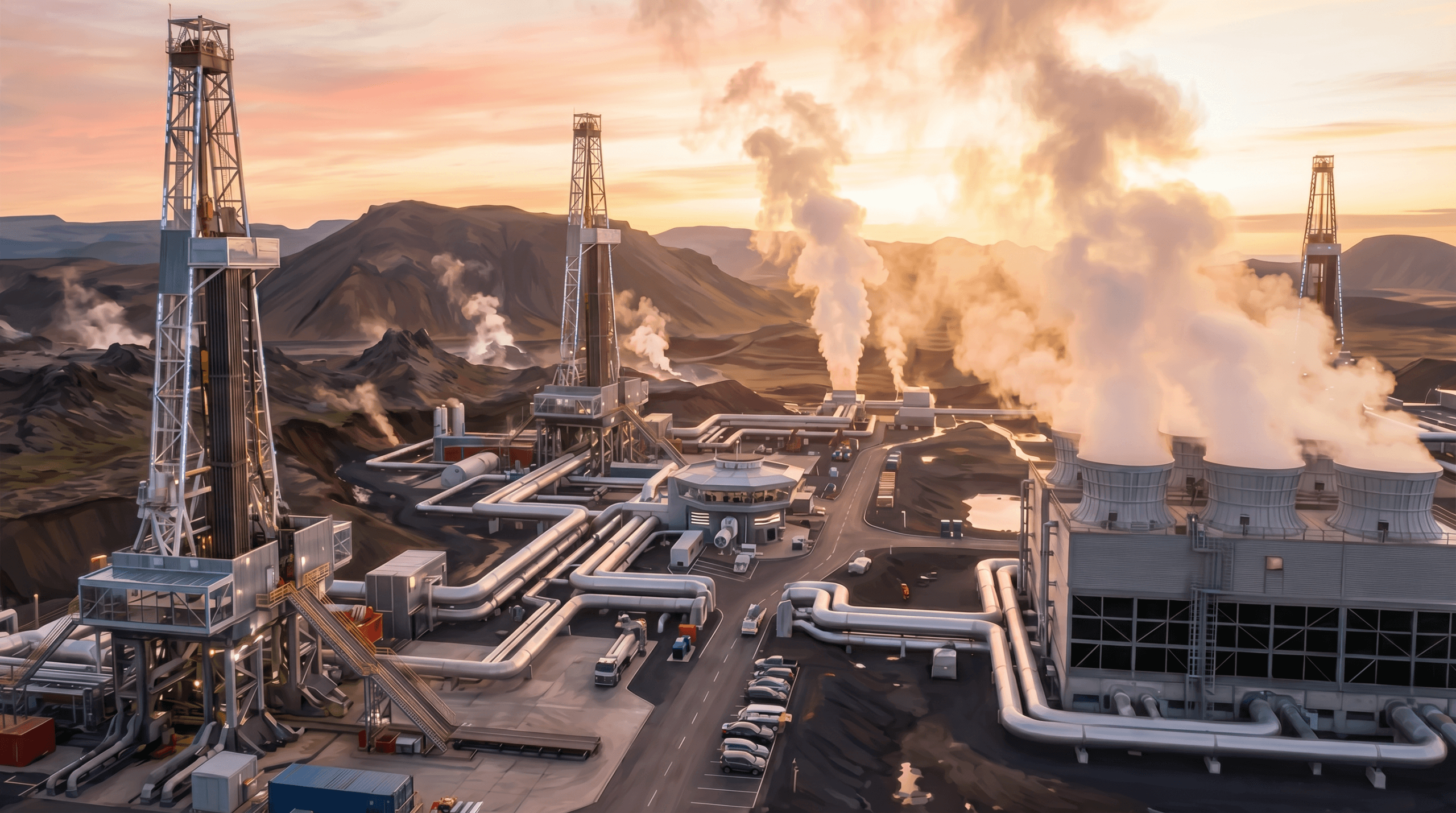
Global Feasibility, Technological Acceleration, and the Integration of Legacy Industrial Infrastructure
The global energy transition is currently characterized by a fundamental shift from variable renewable resources toward a more resilient and sophisticated integration of firm, carbon-free baseload power. Within this emerging energy paradigm, geothermal energy has moved from the periphery to the center of strategic planning. Once limited to a few geographically unique hydrothermal hotspots, the industry is entering what has been termed a “Golden Era” of dominance, enabled by the liberation of technology from traditional geological constraints.[1, 2] This report provides a comprehensive assessment of the feasibility of broad-scale geothermal deployment, the suite of next-generation technologies enabling this expansion, the shifting economic frameworks, the persistent regulatory and technical challenges, and the unique strategic opportunity presented by the repurposing of millions of abandoned and orphaned fossil fuel wells into clean energy assets.
Global Market Dynamics and the Feasibility of Broad-Scale Deployment
The feasibility of broad-scale geothermal energy is fundamentally tied to the industry’s ability to transcend the limitations of naturally occurring hydrothermal reservoirs. Traditionally, geothermal extraction required the “geothermal trifecta” of heat, fluid, and permeability.[3, 4] However, recent advancements in subsurface engineering suggest that these elements can now be engineered, significantly expanding the geographic potential of the resource. By mid-2025, the sector has demonstrated that advanced geothermal systems can be deployed in diverse geological settings, effectively making the Earth’s internal heat a nearly ubiquitous energy source.[5, 6]
The scale of this resource is immense. Estimates suggest that tapping even 0.1% of the accessible heat under the Earth’s surface could meet global energy needs for thousands of years.[5] Current market trajectories reflect this potential. Global geothermal power capacity reached approximately 15.1 GW at the close of 2024, with annual capacity additions reaching their highest levels since 2019.[3] This growth is not merely a continuation of past trends but represents a structural acceleration driven by a new class of “firm” renewable power demands.
| Region/Metric | 2024-2025 Status | 2030-2035 Target/Forecast | Primary Growth Driver |
|---|---|---|---|
| Global Power Capacity | 15.1 GW [3] | 29.5 GW (by 2031) [7] | EGS/AGS Scalability |
| United States Capacity | 3.7 GW [1] | 5.0 GW (by 2030) [1] | DOE “Liftoff” Program |
| New Power Purchase Agreements (PPAs) | 26 signed since 2021 [8] | >1.6 GWe commitment [9] | Data Center/AI Power Demand |
| Enhanced Geothermal Systems (EGS) Potential | Emerging | 90 GW (US by 2050) [1] | Technical Cost Reduction |
| Geothermal Heat Pump (GHP) Value | 1.27m homes (US) [8] | $1 trillion grid value [8] | Peak Demand Alleviation |
In the United States, which currently leads the world in operating capacity, the Department of Energy (DOE) has established a target of 90 GW of geothermal power by 2050.[1] This ambitious goal is predicated on the rapid commercialization of next-generation systems, which accounted for approximately 60% of all geothermal power purchase agreements (PPAs) signed between 2021 and mid-2025.[9] The feasibility of these targets is increasingly linked to the urgent power requirements of the “AI arms race,” where technology companies like Google and Meta are seeking 24/7 firm power to sustain expanding data center fleets.[1, 10] This commercial alignment provides the necessary bankability for large-scale projects, effectively shifting geothermal from an experimental niche to a major component of national energy security.[1, 6]
Enabling Technologies: The Rise of Next-Generation Systems
The transformation of geothermal feasibility is driven by three distinct but overlapping technological revolutions: Enhanced Geothermal Systems (EGS), Advanced Geothermal Systems (AGS), and the pursuit of Superhot Rock Geothermal.
Enhanced Geothermal Systems (EGS) and Subsurface Engineering
EGS represents the most mature of the next-generation technologies, leveraging techniques developed in the unconventional oil and gas sector to create artificial reservoirs in hot, low-permeability rock.[5, 11] The process involves injecting high-pressure fluids to stimulate or create a fracture network, which then serves as a heat exchanger for circulating water.[4, 12]
The success of EGS has been validated through landmark projects such as Fervo Energy’s Project Red in Nevada, which has maintained consistent production for over a year, demonstrating the stability of engineered reservoirs.[13] Key technological enablers in this field include horizontal and directional drilling, which allow a single wellhead to access a vast volume of hot rock by steering the drill bit through high-temperature formations.[5, 14] Furthermore, the use of zonal isolation and multi-stage fracturing—standard in the shale industry—allows for the creation of uniform fracture networks that maximize heat recovery while minimizing fluid loss.[11]
Advanced Geothermal Systems (AGS) and Closed-Loop Architectures
In contrast to EGS, which relies on direct fluid-rock contact, AGS or “closed-loop” systems utilize a sealed wellbore that functions as a downhole heat exchanger.[13, 15] This approach eliminates the need for natural permeability and the use of hydraulic fracturing, thereby mitigating concerns regarding induced seismicity and water management.[11, 15]
AGS designs often feature long horizontal multi-laterals, sometimes configured as a “U-tube” or a “coaxial” radiator system, where working fluids like water or supercritical CO2 absorb heat through conduction from the surrounding rock.[4, 11, 15] While the heat transfer rate in closed-loop systems is inherently lower than in fracture-based systems due to the limits of conduction, the technology offers unparalleled geographic flexibility.[15, 16] Companies like Eavor Technologies and Sage Geosystems are currently leading the commercial demonstration of these systems, targeting areas with lower-temperature gradients that were previously considered unsuitable for geothermal power.[9, 11]
Superhot Rock and Extreme Environment Engineering
The most energy-dense opportunity in geothermal lies in Superhot Rock systems, which target temperatures exceeding 375°C.[4, 14] At these temperatures and corresponding pressures, water becomes supercritical—a phase where it exhibits the density of a liquid and the viscosity of a gas.[4] Supercritical water can carry approximately ten times more energy than sub-critical steam, potentially allowing a single geothermal well to produce an order of magnitude more power than conventional wells.[4, 14]
Realizing this potential requires overcoming significant material science challenges. Standard drilling equipment, sensors, and casing materials must be redesigned to withstand the caustic and extreme conditions found at depths of 4 to 7 kilometers.[14, 17] Current research is focused on high-temperature electronics, advanced metallurgy, and anti-fouling coatings to prevent the precipitation of salts and silica that can foul boreholes in superhot environments.[4, 14]
Economic Assessment and the Shifting Financial Landscape
The economics of geothermal energy are undergoing a fundamental re-evaluation as grid operators and corporate buyers place an increasing premium on “firm” (always-on) power. While the Levelized Cost of Electricity (LCOE) for geothermal remains higher than that of solar or wind, the value it provides in balancing a grid dominated by variable renewables is becoming a decisive factor in its adoption.[7, 18]
LCOE Comparisons and Cost-Reduction Targets
As of 2025, the global weighted average LCOE for geothermal is approximately $68/MWh, compared to $39/MWh for fixed-tilt solar and 40/MWhforonshorewind.[7,19]However,whencomparedtootherbaseloadsourceslikenuclear(258/MWh) or natural gas with carbon capture, geothermal is increasingly competitive.[5, 19]
| Technology | 2025 LCOE ($/MWh) | 2035 Target ($/MWh) | Capacity Factor (%) |
|---|---|---|---|
| Geothermal (Conventional) | $68 [7] | ~$50 [5] | 85-90% [3] |
| EGS (Next-Gen) | 64−111 [13] | $45 [20] | 90%+ [13] |
| Solar PV (Fixed-tilt) | $39 [19] | Stabilizing | 20-30% |
| Onshore Wind | $40 [19] | Stabilizing | 30-45% |
| Nuclear (Conventional) | $258 [19] | N/A | 90%+ |
The DOE’s “Enhanced Geothermal Shot” aims to reduce the cost of EGS by 90% to $45/MWh by 2035.[20, 21] This target is supported by rapid learning curves in drilling; for example, developers have reported a 70% reduction in drilling time per well through the application of advanced PDC bits and optimized drilling fluids.[1]
Policy Incentives and Financing Trends
The geothermal sector is currently benefiting from robust policy support in major markets. In the United States, the One Big Beautiful Bill Act (OBBBA) of 2025 maintained and expanded tax credits for geothermal power and heating, even as it phased out credits for other renewable sectors.[22, 23] Specifically, Section 48 Investment Tax Credits (ITC) provide up to 30% coverage for geothermal projects that meet domestic content and labor standards.[23, 24]
Simultaneously, the financing model for next-generation geothermal is maturing. While early projects relied almost entirely on equity, the industry saw a significant shift toward debt financing in 2024-2025. Financing for the sector reached nearly $2.2 billion in 2025—an 80% increase year-over-year—with debt now accounting for nearly 30% of the total.[6] This transition signals growing investor confidence in the technical performance and long-term bankability of EGS and AGS projects.[6]
Technical, Regulatory, and Environmental Challenges
Despite the positive momentum, broad-scale geothermal adoption faces several formidable barriers that threaten the pace of deployment.
Permitting Reform and Regulatory Uncertainty
Permitting remains the single greatest non-technical hurdle for geothermal projects, particularly in the United States, where a significant portion of high-potential resources are located on federal lands.[20, 25] Current timelines for environmental reviews under the National Environmental Policy Act (NEPA) can range from six months to several years, creating a “valley of death” for project financing.[20]
To address this, 2025 has seen a surge in legislative efforts to streamline the process, including the introduction of the “Geothermal Gold Book Development Act” and the “Geothermal Energy Opportunity (GEO) Act”.[25] These bills aim to create categorical exclusions for minor exploration activities and establish hard timelines for agency decisions.[25] However, the 2025 “purge” of geothermal research and data from official U.S. government sources has introduced a new layer of regulatory uncertainty, as industry participants struggle to access the historical datasets necessary for resource mapping and environmental baseline studies.[26, 27]
Induced Seismicity and Public Perception
The use of hydraulic stimulation in EGS has historically raised concerns about induced seismicity.[11, 12, 28] While modern monitoring and “traffic light” systems have proven effective at managing these risks, public perception remains sensitive, particularly in regions with little history of oil and gas activity.[12, 29] The industry must maintain high levels of transparency and community engagement to avoid the “NIMBY” (Not In My Backyard) challenges that have hindered other energy sectors.[25, 28]
Geochemical Challenges: Scaling, Corrosion, and Methane
Geothermal fluids are often complex chemical cocktails containing high concentrations of silica, chlorides, and dissolved gases like hydrogen sulfide (H2S) and methane (CH4).[28, 30] Scaling in pipes and heat exchangers remains a primary cause of operational downtime and efficiency loss.[14, 31] Furthermore, while geothermal is often characterized as a zero-emissions resource, some open-loop systems can release small amounts of greenhouse gases if not properly managed.[28, 30] Advanced closed-loop designs and gas-reinjection retrofits, such as those implemented at New Zealand’s Tauhara plant, are becoming the global standard for minimizing these environmental impacts.[3, 28]
Repurposing Abandoned and Orphaned Fossil Fuel Wells
One of the most innovative pathways to broad-scale geothermal feasibility is the repurposing of existing fossil fuel infrastructure. With millions of abandoned or orphaned wells worldwide, this approach offers a dual benefit: mitigating a significant environmental liability and providing a low-cost entry point for geothermal energy production.[32]
Technical Feasibility and Heat Extraction Modeling
Repurposing involves converting a depleted hydrocarbon well into either an open-loop co-production system or a closed-loop borehole heat exchanger.[31, 33] In co-production, the hot “produced water” that typically accompanies late-stage oil and gas production is used for heat or power generation before being reinjected.[34, 35] In the closed-loop scenario, a downhole heat exchanger is installed, and a working fluid is circulated through the existing wellbore to absorb heat from the surrounding formation.[31, 33]
The technical yield of these systems is governed by the heat transfer efficiency, often modeled using the relationship for conductive heat flow:
Q=−k⋅A⋅∇T
Where Q represents the heat extraction rate, k is the thermal conductivity of the rock, A is the wellbore surface area, and ∇T is the geothermal temperature gradient.[16] Research in Alberta has shown that while these systems are technically feasible, their performance is highly sensitive to the lateral length of the well and the local geothermal gradient, which typically ranges from 25°C/km to 45°C/km in sedimentary basins.[16, 31]
Economic Advantages and Infrastructure Arbitrage
The primary economic appeal of repurposing is the avoidance of drilling costs, which can account for up to 50% of a greenfield geothermal project’s total expenditure.[36, 37, 38] By utilizing an existing well, developers can save between $1.5 million and $8 million in capital costs.[31, 39] Furthermore, the availability of historical geological data, well logs, and seismic surveys from decades of oil and gas exploration significantly reduces “exploration risk,” making these projects more attractive to early-stage investors.[36, 39, 40]
| Project/Region | Well Type | Geothermal Application | Status/Key Finding |
|---|---|---|---|
| TRANSGEO (Central Europe) | Abandoned Hydrocarbon | District Heating/Storage | Mezőcsát-1 well active [41] |
| Savica-1 (Croatia) | Abandoned Oil/Gas | BTES Thermal Storage | Feasibility complete (2025) [41] |
| Gradient Geothermal (CO, US) | Orphaned Wells | Rural Electricity/CCS | Pilot study in progress [42] |
| Tuttle Project (OK, US) | Inactive Oil/Gas | Direct Heat (Schools) | Successful demonstration [43] |
| Alberta (Canada) | Inactive Wells | Closed-loop Power | 500k wells potential [16] |
Environmental Liability Mitigation and Carbon Credits
Orphaned wells are a major source of rogue methane emissions, contributing up to 6% of the total methane output from abandoned wells in the United States.[44] Repurposing these wells into geothermal assets provides a funding mechanism for the “plug and abandon” (P&A) process, effectively sealing the well against methane leaks while generating renewable energy.[42, 44] The voluntary carbon market (VCM) has already begun issuing credits for these projects, with approximately 8.3 million credits issued for orphaned well plugging as of 2025.[44] This integration of carbon finance and renewable energy production creates a powerful economic incentive for oil companies to manage their legacy liabilities responsibly.[44]
Geothermal Heat Pumps and District Energy Networks
While much of the strategic focus is on power generation, the “thermal” side of geothermal energy—specifically Geothermal Heat Pumps (GHPs) and Thermal Energy Networks (TENs)—offers some of the most immediate benefits for broad-scale grid decarbonization.
Alleviating Grid Constraints
GHPs utilize the stable temperature of the shallow subsurface to provide efficient heating and cooling for buildings.[8, 23, 24] Oak Ridge National Laboratory estimates that deploying GHPs in just 68% of single-family homes in the US could reduce electrical system costs by over $300 billion by 2050.[8] By shifting heating loads from the air to the ground, GHPs significantly reduce peak winter demand, potentially avoiding the need for 43,500 miles of new transmission lines.[8, 20]
The Expansion of Thermal Energy Networks (TENs)
A rising trend in 2024-2025 is the development of utility-scale Thermal Energy Networks, where multiple buildings are connected to a shared geothermal loop.[8] In Massachusetts, Eversource Energy commissioned a pilot project in 2024 that connects 36 buildings to a network of 3 borehole fields, demonstrating how gas utilities can transition their infrastructure and workforce to manage renewable heat.[8] This “networked” approach overcomes the high upfront cost for individual homeowners and allows for the recovery of waste heat from industrial processes, further improving system efficiency.[8]
Conclusion: The Strategic Roadmap for Geothermal Energy
The feasibility of broad-scale geothermal energy is no longer a question of “if” but of “how fast.” The technological convergence of EGS, AGS, and supercritical systems has provided the tools necessary to unlock the Earth’s heat on a global scale. The economics are being reshaped by the urgent need for firm power, and the repurposing of legacy oil and gas infrastructure provides a pragmatic pathway to scale.
However, the industry’s success remains contingent on navigating a complex landscape of regulatory hurdles and environmental responsibilities. The 2050 target of 90 GW in the United States, and the European goal of 250 GW by 2040, will require a sustained commitment to permitting reform, data transparency, and public trust.[1, 45] If these challenges are met, geothermal energy is poised to become the bedrock of the 21st-century energy system—a reliable, carbon-free, and domestic source of power that can meet the needs of a digital and industrialized world.
——————————————————————————–
- Trump administration’s policies support rapid growth of geothermal …
- The Future of Geothermal Energy – Microsoft .NET
- GSR 2025 | Geothermal – REN21
- Enhanced geothermal systems (EGS) – Department of Energy
- Deploy Advanced Geothermal Energy | Project Drawdown®
- Investment in next-generation geothermal is surging. Policies are key to further growth – Analysis – IEA
- Geothermal Energy Market Size, Growth Analysis & Trends 2031 – Mordor Intelligence
- 2025 U.S. Geothermal Market Report | NLR – National Laboratory of the Rockies
- 2025 U.S. Geothermal Market Report – Publications – National …
- Unlocking Geothermal Energy Potential through Geoscience, Geospatial Data – AAPG
- What are the technological innovations in geothermal energy and where are they headed? | by Adam Erlichman | TDK Ventures | Medium
- Barriers Holding Back Geothermal Energy Adoption – Net Zero Insights
- Next-generation geothermal power | Niskanen Center
- Next-generation geothermal energy: Promise, progress, and challenges | MIT Climate Portal
- Advanced Geothermal Systems (AGS) – GA Drilling
- Repurposing Wells | Geothermal Energy Lab – University of Calgary
- Application of well logging technology in geothermal resource evaluation: A case study of geothermal water wells in the Qianjiang sag, Jianghan Basin – PMC
- Geothermal Energy Market Size & Share, Tends Report 2035
- Solar LCOE saw ‘anomalous’ 6% rise between 2024 and 2025 – PV Tech
- Geothermal Publications | Department of Energy
- Renewables Global Status Report 2025 – Geothermal Power and Heat – Endnotes | REN21
- 2026 Renewable Energy Industry Outlook | Deloitte Insights
- Geothermal heat pump systems tax incentives | Our Insights – Plante Moran
- Tax Credits, Incentives, and Technical Assistance for Geothermal Heat Pumps
- Thoughtful permitting reform can help expand next-generation geothermal
- 2025 United States government online resource removals – Wikipedia
- Disappearing Data, Part II: Distorted Science and Deregulation | National Security Archive
- Environmental Impacts of Geothermal Energy | Union of Concerned Scientists
- The arrival of geothermal in American energy policy – Brookings Institution
- Geothermal Energy | U.S. Fish & Wildlife Service
- Repurposing abandoned oil and gas wells for geothermal energy …
- Repurposing Abandoned Oil and Gas Wells for Geothermal Applications – Illinois Experts
- Abandoned Oil and Gas Wells as an Alternative Geothermal Energy Source: Current Practices and Way Forward – ASCE Library
- Offshore Geothermal Energy Perspectives: Hotspots and Challenges – MDPI
- Repurposing oil and gas infrastructure, a geothermal revolution in the North Sea?
- The reuse of abandoned wells to boost geothermal energy production – YouTube
- The importance of high-resolution seismic in geothermal exploration – ThinkGeoEnergy
- Utilization of Oil and Gas Wells for Geothermal Applications – Stanford School of Earth, Energy & Environmental Sciences |
- Geothermal Exploration Drilling – SLB
- Geothermal Exploration: Seismic Data & Renewable Energy – Fairfield Geotechnologies
- Using abandoned wells for geothermal energy production
- Gradient Geothermal joins Colorado study to repurpose abandoned oil wells for geothermal energy – ThinkGeoEnergy
- Repurposing Oil/Gas Wells for Geothermal Applications: an Experimental Study on Geochemical Impacts of the Cycling System
- Technical Explainer: Orphaned Oil and Gas Well Carbon Credits – RMI
- EGEC unveils 9 recommendations for the EU’s Geothermal Strategy and Action Plan to ensure affordability, energy security and competitiveness
Cited in Report
45
Not cited
24