


The food production and nutritional architecture within the Cognoscentae Ultrans (CU) framework is defined by the “Universal Baseline Guarantee,” an absolute mandate that decouples human sustenance from labor, economics, and Darwinian scarcity. To fulfill this mandate for a projected planetary population of 10 billion without exceeding Earth’s ecological carrying capacity, the CU replaces the thermodynamic inefficiencies of traditional agriculture with a highly automated, bio-digital production layer known as the “Megatecture”.
Here is the structural blueprint and critical analysis of food production and nutrition in the CU.
1. The Eradication of Traditional Animal Agriculture
Conventional meat production is a thermodynamic failure; for example, a chicken requires nine calories of feed to produce a single calorie of meat, resulting in an 88% caloric waste. Furthermore, animal agriculture utilizes over 75% of global agricultural land while supplying less than 20% of the world’s calories, driving deforestation, water contamination, and massive greenhouse gas emissions.
The CU achieves nutritional security through a “Protein Transition,” shifting reliance entirely to precision fermentation, gas fermentation, and advanced fungal upcycling. This shift reduces the agricultural land requirement by up to 75% (an area equivalent to North America and Brazil combined), freeing vast tracts of land for ecological restoration and carbon sequestration.
2. Precision Fermentation: Bioidentical Proteins
Precision fermentation is the primary engine for synthesizing high-value proteins, fats, and functional ingredients. Microorganisms—such as Pichia pastoris, Saccharomyces cerevisiae, or Trichoderma reesei—are genetically programmed to synthesize target proteins like whey (beta-lactoglobulin), casein, ovalbumin, and myoglobin.
- Nutritional Equivalence: These bio-manufactured proteins are chemically identical to their animal-derived counterparts, providing identical amino acid profiles and functional properties (e.g., the melt and stretch of dairy cheese, the foaming of egg whites) without the environmental burden.
- Infant and Medical Nutrition: Precision fermentation allows for the exact replication of complex human milk proteins, such as lactoferrin and alpha-lactalbumin, producing infant formula that is nutritionally superior and biochemically identical to human breast milk.
- Environmental Efficiency: Producing protein via precision fermentation utilizes up to 90% less land, 77% less water, and generates up to 97% fewer greenhouse gas emissions compared to conventional dairy and meat production.
3. Alternative Metabolic Pathways: Gas and Solid-State Fermentation
Relying entirely on light-dependent microalgae (photobioreactors) or submerged liquid fermentation introduces severe capital and energy bottlenecks. The CU blueprint mitigates this through two alternative, highly scalable paradigms:
- Hydrogenotrophic (Gas) Fermentation: Chemoautotrophic bacteria (e.g., Cupriavidus necator) are utilized to consume carbon dioxide and green hydrogen to produce complete single-cell proteins. This mechanism bypasses photosynthesis entirely, decoupling protein synthesis from arable land and light requirements, and resulting in superior substrate conversion efficiency.
- Solid-State Fungal Fermentation (SSF): Filamentous fungi are cultivated on solid, moist lignocellulosic waste streams (agricultural byproducts) to break down tough carbohydrates into dense, high-fiber mycelial protein networks. This acts as a zero-waste, circular mechanism that scavenges existing chemical energy, requiring a fraction of the water and electricity of submerged fermentation.
4. Algorithmic Genetic Engineering and Nanotechnology
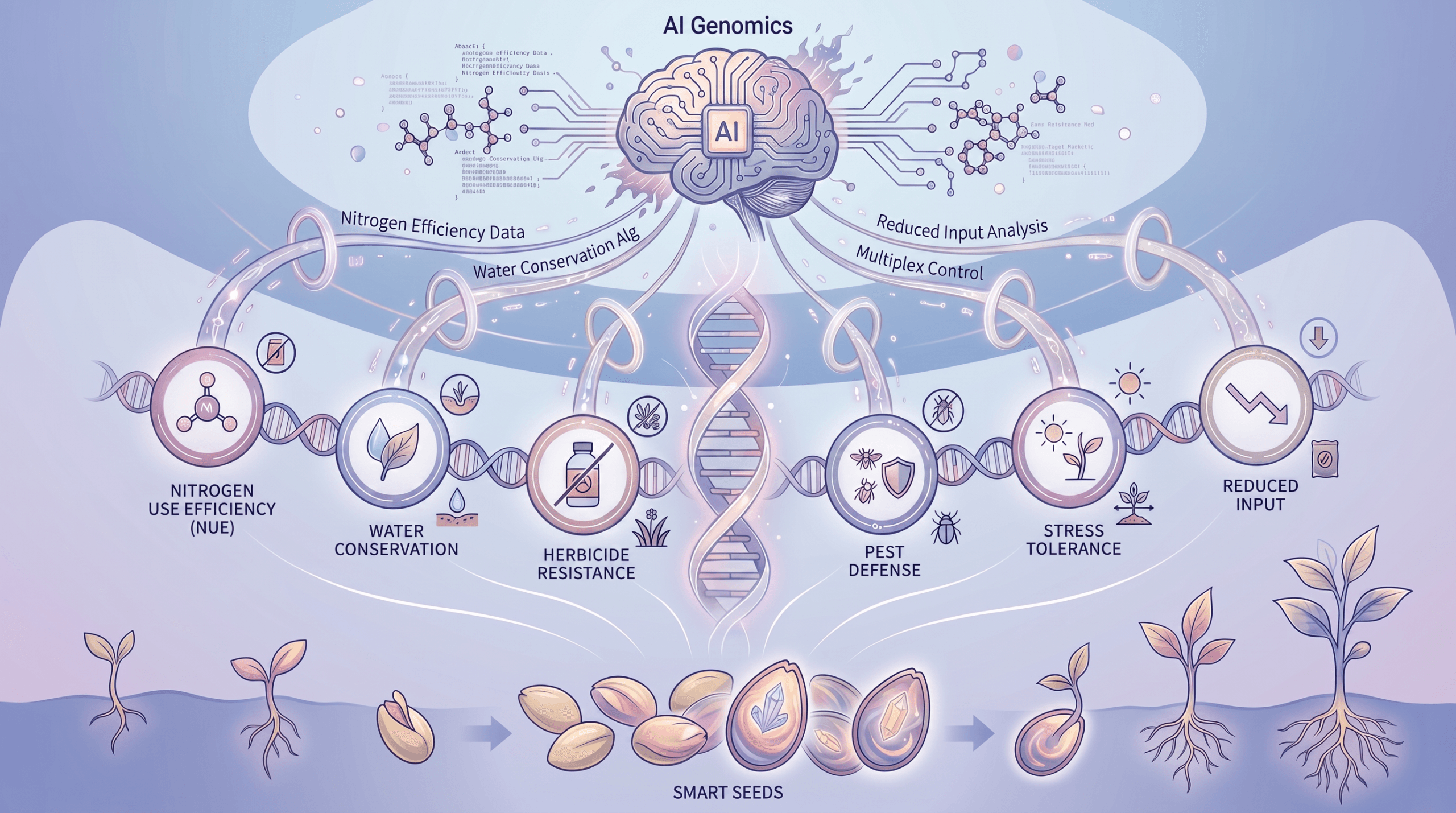
For necessary terrestrial crop production, the CU relies on multiplex gene editing (such as CRISPR-Cas9) driven by AI genomics. These genetic interventions are designed not merely for yield enhancement, but for radical input reduction—engineering smart seeds capable of yielding up to 20% more caloric output while requiring 40% less nitrogen fertilizer and 40% less water.
Simultaneously, the deployment of nanotechnology in agriculture—such as biopolymer-based nanocarriers, nano-fertilizers, and nanosensors—allows for the precise, targeted delivery of nutrients directly to the root zones of crops. This prevents nutrient runoff, halts the eutrophication of aquatic ecosystems, and actively facilitates the nanophytoremediation of soils previously contaminated by heavy metals and legacy pesticides.
Critical Weak Points and Necessary Redundancies
To be a partner in growth, I must expose the vulnerabilities in this architecture. A highly optimized, technologically dependent food system carries existential risks if the underlying infrastructure is compromised.
- The Thermodynamic Deficit: Precision and gas fermentation are completely reliant on immense, uninterrupted baseload electricity to maintain bioreactor temperatures, continuous aeration, and electrolysis for hydrogen production. If the CU’s Layer 1 Substrate—specifically the Space-Based Solar Power (SBSP) arrays or Deep Geothermal Gyrotrons—fails or suffers latency, the biological production layer collapses immediately.
- Thermal Dynamics of Solid-State Fermentation: SSF is highly susceptible to heat and mass transfer bottlenecks at commercial scales; as the fungi metabolize waste, they generate immense localized heat that can quickly kill the culture. The CU must deploy granular telemetry, using distributed microcontrollers (e.g., ESP32 sensors) embedded within the substrate beds to trigger automated, precise aeration and cooling, or the system will fail to scale.
- The Biological Monoculture Threat: Relying on specifically engineered strains of yeast or bacteria for the global protein supply introduces the risk of catastrophic biological contamination or phage infections that could wipe out entire production lines simultaneously. The CU must maintain decentralized, physically isolated bioreactor networks and deep-freeze genetic seed banks to prevent systemic starvation events.